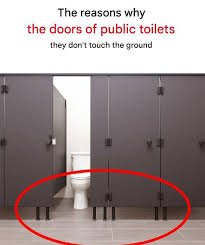
It may seem surprising, but the design also encourages people to use the restroom more quickly.
Psychologically, people feel:
-
Less comfortable lingering
-
More aware of the outside environment
-
More pressured to finish quickly
This matters in public places where restroom lines can become long. The quicker someone leaves, the faster others can enter.
10. It’s Simply More Practical for Public Spaces
While some people prefer full privacy, the design of public restrooms is based on practicality, not luxury. The goal is to keep:
-
Traffic moving
-
Maintenance simple
-
Spaces safe
-
Costs low
Every aspect of the design—including the gaps—helps ensure that public restrooms function smoothly in high-use environments.
11. Why Full-Length Doors Are Rare in the U.S.
In some countries, restroom stall doors extend from floor to ceiling. This is more common in:
-
Some European countries
-
Middle Eastern countries
-
Japan
However, in the United States, public restroom designs follow a different standard—one that prioritizes:
-
Cost efficiency
-
Quick cleaning
-
Safety
-
Accessibility
Installing full privacy stalls in every public building would significantly increase construction and maintenance costs. For high-traffic U.S. restrooms, the open-bottom design remains the most efficient choice.
12. Will This Design Ever Change?
Some modern restaurants, airports, and hotels in the U.S. have started adding higher-quality restroom stalls with:
-
Taller doors
-
Smaller gaps
-
Improved privacy
But full-coverage stalls are still expensive, and most public places rely on traditional designs.
Unless building codes change nationwide, the classic door-gap design will remain the standard in most public spaces.
Final Thoughts
The gap at the bottom of public restroom doors may seem strange at first, but it’s actually one of the most practical design choices for busy public spaces. It helps with cleaning, ventilation, safety, cost control, and smooth restroom traffic. While it may reduce privacy a bit, it dramatically improves functionality.